Darknet Infrastructure 2026: How Hidden Services and Onion Routing Actually Work
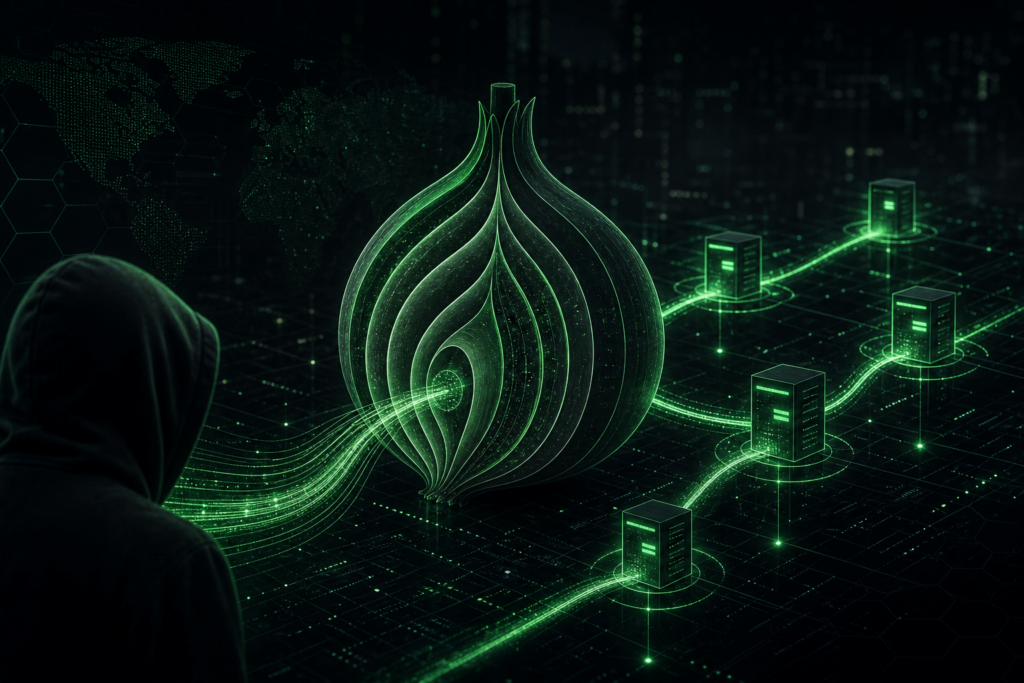
When most people talk about Tor hidden services, they treat the infrastructure as a black box: traffic goes in, anonymity comes out, and the mechanics are left to the protocol designers. For the researcher or market analyst who actually needs to understand whether a given .onion is secure, that black box is a liability. The gap between the theoretical design of onion routing and its practical deployment in 2026 is where operational security either holds or collapses – and it collapses far more often than the hype around “darknet infrastructure” would suggest.
The Protocol That Was Never Supposed to Be Public
Onion routing was developed in the mid-1990s at the U.S. Naval Research Laboratory by Paul Syverson, Michael G. Reed, and David Goldschlag to protect U.S. intelligence communications online. It was then refined by DARPA and patented by the Navy in 1998. The core concept is deceptively simple: messages are wrapped in multiple layers of encryption, and each router in a chain peels off one layer to learn only the next hop. The sender remains anonymous because each intermediary knows only the immediately preceding and following nodes. Nothing in the original design contemplated hosting public-facing websites that would serve thousands of users daily. The hidden service protocol was bolted on later, and that lateness shows in the operational complexity.
In theory, a properly configured hidden service works like this: the web server – Apache, Nginx, whatever – binds exclusively to 127.0.0.1. The Tor daemon on the same machine creates a virtual tunnel, accepting connections from the Tor network and forwarding them to the local server. The server’s real IP is never exposed to the visitor because traffic terminates at the Tor daemon, not at the web server directly. That is the theory. In practice, as researchers at SOS Intelligence document through their continuous DARKSEARCH platform crawls, operators routinely fail at this single configuration step. And when they fail, the entire anonymity model breaks.
Where the Leaks Actually Come From
The most survivable leaks in hidden service infrastructure are not cryptographic breaks. They are configuration errors. The classic case – Apache’s mod_status – has been documented since at least 2001, and it continues to surface on live hidden services in 2026. When enabled and exposed to the Tor network, mod_status serves a page containing the server’s real hostname, virtual host configuration, and sometimes active connection details including clearweb IP addresses of other visitors or the server’s own outbound connections. The server name field alone often carries the hostname that resolves directly to a clearweb IP.
Certificate Transparency (CT) logs provide an even quieter vector. When a hidden service operator obtains an SSL certificate – from Let’s Encrypt, Comodo, or any public CA – that certificate is logged in public CT logs searchable via crt.sh. If the same certificate is used on both the hidden service and a clearweb server, or if the Subject Alternative Names (SANs) include the server’s clearweb domain, the link between the .onion address and the clearnet identity is trivial to establish. This is not an edge case; it is a recurring pattern that intelligence analysts use daily.
Even seemingly minor leaks add up. Apache error pages – 403 Forbidden, 404 Not Found – often include server signature information in the response headers. During crawls in early March 2026, researchers identified multiple hidden services returning these pages with Apache version strings still intact. A server signature by itself is not a deanonymization event, but it provides a fingerprint that can be cross-referenced with Shodan or Censys to narrow down the server’s identity. PHP phpinfo() pages, when left accessible, leak everything from the server’s real hostname to the loaded modules and operating system version. Each piece is a tile in a mosaic that, assembled, reveals the physical hosting location.
The Infrastructure Behind the Infrastructure
The hidden services we analyze do not exist in isolation. They sit on top of a professionalized underground services economy that, according to Chainalysis data cited in recent threat intelligence, supports roughly $3.2 billion in global underground economic activity, with criminal-as-a-service offerings alone worth approximately $700 million. Bulletproof hosting providers – predominantly operating from Southeast Asia and Eastern Europe – form the bedrock. These companies design their offerings explicitly to resist takedowns, ignore abuse complaints, and withstand law enforcement pressure. When a marketplace goes down, another opens within days because the underlying hosting infrastructure remains intact and available for hire.
| Torzon Market |
torzon7aphar3x4l5b77nsylgyw26kntbi4m2wemrjh72aczeh27f6qd.onion
|
| DrugHub |
drughuj7l72ig56pza77eriu7yh6qsao4xb4yasq2qfjusxzuq6rlwqd.onion
|
| DarkMatter |
darkmafmzgnsmow5z3spgludhpwxhwbg77oam433fjx3clzh2yp2oaid.onion
|
| Omega Market |
omega7yhz7n4vg4yhf2na2qaaaeatdlqvjbj2juc245mr5muxtnuvgyd.onion
|
| BlackOps |
blackoogcnxogvymmebfwfjhx4k7efpgeoeytxtsev2lc4pqlbz54qad.onion
|
This shift is why targeting individual marketplaces has diminishing returns. The services economy has collapsed the technical barrier to entry. A decade ago, launching a dark web marketplace meant running everything yourself: hosting, payment processing, dispute resolution, vendor management. That overhead limited the field to determined operators. Today, someone can outsource the entire stack to purpose-built providers. The hidden service itself becomes a thin presentation layer over a resilient backend that survives individual seizures.
The Discovery Problem and the Directory Layer
All of this infrastructure is useless if users cannot find it. On the surface web, domain names serve as mnemonic anchors. On the darknet, a legitimate URL looks like 56 characters of random letters and numbers. A phishing URL differs by a single character. Because humans cannot memorize these strings, threat actors flood dark web search engines and forums with fake links. The result is that searching for a marketplace directly is one of the fastest ways to lose your credentials and your wallet.
Professional OSINT investigators and experienced users do not rely on search engines for this reason. Instead, they use curated directories such as Tor.Taxi and Dark.Fail. These directories serve as the darknet’s equivalent of a verified phone book, maintained by analysts who manually verify each .onion link and update their listings as markets migrate or get seized. The directories themselves are hidden services, and they remain operational only because their operators understand the configuration discipline described earlier. They bind their servers to localhost, they do not reuse SSL certificates across clearweb domains, and they strip server signatures from error pages.
Operational Realities for 2026
For anyone running or monitoring hidden services, the lessons are concrete and unforgiving. First, check that your web server binds exclusively to 127.0.0.1. A single public-facing listener defeats the entire purpose of using Tor. Second, audit every SSL certificate. If the certificate appears in CT logs with a SAN pointing to a clearweb domain, the link is permanent and public. Third, disable mod_status, remove phpinfo(), and suppress server signature headers. These are not optional hardening steps; they are the baseline for operational security.
For analysts, the same misconfigurations are intelligence gold. Each exposed server header, each recycled certificate, each phpinfo() page is a breadcrumb that leads from the .onion address to a hosting provider and potentially to an individual operator. The techniques are not new, and they do not require breaking cryptography. They only require that the target made a mistake. In an ecosystem where the barrier to entry has collapsed, mistakes are the norm, not the exception.